Monday, June 17, 2013

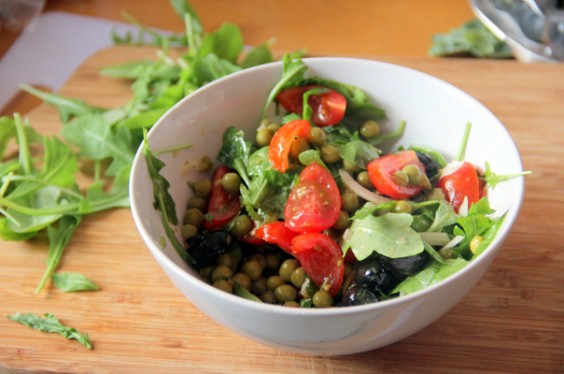
Veggie-Packed Arugula Salad


Arugula is a powerful green with a peppery bite, which is why I often find its flavor hard to enjoy alone in a salad. However, adding a few other add-ins to soften its kick changes the flavor completely.
 
Sure, all salad greens are healthy and low in calories, but arugula stands out. Compared to iceberg lettucearugula has more than eight times more calcium, nearly five times more vitamin A, vitamin C, and vitamin K and four times more iron in the same serving size.
 
With the smooth texture of peas, the softness of olive oil, the freshness of cherry tomatoes, and the dense texture and full-flavored nature of olives, arugula is both complemented and challenged in this salad.

Ultimately, the green emerges as the centerpiece. Enjoy!

 Veggie-Packed Arugula Salad

 
Arugula Salad
Serves 1
What You‘ll Need:
2 large handfuls of fresh arugula leaves
6-8 cherry tomatoes, quartered
6-8 black olives, pitted
1/4 white onion, diced
3/4 cup peas, rinsed (canned, frozen, or fresh work!)
1/4 cup extra-virgin olive oil
1/4 teaspoon mustard
1 lemon, juiced
Sea salt and black pepper, to taste
 
What To Do:
  1. Toss together arugula leaves with tomatoes, olives, peas, and onions.
  2. In a separate bowl, whisk together the remainder of the ingredients.
  3. Pour the dressing over the arugula leaf and vegetable mixture and toss until evenly combined.
  4. Serve and enjoy!
This recipe and photo were created by contributor Aylin Erman of Glow Kitchen

Friday, June 14, 2013

51 Paleo Snacks Anyone Can Love

 by David Tao

51 Paleo-Friendly Snacks
No grains? No problem. Paleo eaters may shun grains, processed vegetable oils, and refined sugars, but that doesn’t stop them from enjoying plenty of delicious dishes — and creating some downright ingenious recipe substitutions. Whether you’re a longtime primal eating fanatic or just curious about what it’s like to go back to dietary basics, we’ve got 51 delicious Paleo-approved snacks for whenever hunger strikes.

Paleo Classics

Cauliflower Popcorn
1. Cauliflower Popcorn
Corn is a Paleo no-no, so replace the movie favorite with a more nutritious cauliflower version that has a similar buttery taste and satisfying crunch.
2. Bacon and Guacamole Sandwiches
We’re kicking ourselves for not thinking of this one sooner. Michelle Tam, founder of Nom Nom Paleo, has some sage advice here: Slap a tablespoon (or two) of guacamole between strips of crispy bacon for a mini-sandwich combo every Paleo enthusiast can love.
3. Deconstructed Guacamole
For a filling, colorful salad, combine cubed avocado and diced tomato with lemon juice and your favorite seasonings. Best if the avocados aren’t too ripe so they’ll keep some shape.
4. Paleo Hummus and Veggie Slices
Going Paleo means saying goodbye to traditional hummus. This recipe swaps cauliflower for chickpeas for a substitute that will fool all but the most astute hummus connoisseurs. Serve with slices of your favorite dip-able vegetables.
5. Baba Ghanoush and Sesame Crackers
Eggplants are Paleo-friendly for most, but store-bought baba ghanoush can still contain loads of hidden mayo — and that can mean a lot of unwanted vegetable oils. Go for a simple, mayo-free recipe with lots of garlic for a fresher take that won’t weigh you down. Try pairing this dip with some Paleo-friendly homemade sesame crackers.
6.Prosciutto Wrapped Melon
A sweeter combo than the one above, this easy recipe requires zero cooking. Pick a favorite in-season melon (cantaloupe and honeydew work well) and wrap with preservative-free prosciutto for a juicy snack with a salty kick that’s tops for finger food.
7. Prosciutto Wrapped Asparagus
Roast asparagus, then wrap in a preservative-free prosciutto for a snack that will also impress as an appetizer. Serve with egg yolks as an optional dipping sauce (go for the pasteurized variety if raw egg isn’t your thing).
8. Shrimp Cocktail
Start simple with the original cocktail. Serve this protein-rich snack with sugar-free cocktail sauce for an added kick.
9. Bacon-Roasted Brussels Sprouts
Brussels sprouts are a much-maligned green, but we’ve learned to love this superfood in almost every form. Roast with diced bacon — and some extra bacon grease — and there’s even more to celebrate.
10. Chicken-and-Egg-Stuffed Tomatoes
Combine cooked diced chicken and hardboiled egg with a simple vinaigrette and then stuff into hollowed-out beefsteak tomatoes. Garnish with paprika for flavor and color.
11. Guacamole Deviled Eggs
Mash hardboiled egg yolks with avocado with a dash of lemon juice, then stuff into egg whites for a greener take on deviled eggs. Bet you can’t eat just one! (We couldn’t eat just four.)
Egg Muffins
12. Egg Muffins
Miss muffins on Paleo? Try this version — basically mini omelettes baked in a muffin tin — for an infinitely customizable snack. Fill with your favorite veggies and meats, top with cheese (or go without), and enjoy for breakfast or whenever a snack craving hits.
13. Avocado with Sunflower Seeds
Halve and pit a ripe avocado and fill the center cavity with roasted sunflower seeds for a quick treat with contrasting textures.
14. Green Eggs
We’ll pass on the green ham for now, but this recipe gets the thumbs up. Blend eggs with a few leaves of superfood kale — keep the leave on the stalks! — and scramble for a nutrient- and fiber-packed twist on the classic omelet.
15. Homemade Trail Mix
Let’s face it: A lot of the best-tasting trail mixes aren’t the best for Paleo peeps, since sugar-coated dried fruit, milk chocolate morsels, and peanuts often take center stage. Make your own version at home by opting for nuts like almonds and macadamias, and no-sugar-added dried fruit for a touch of sweetness.
16. Bacon-Wrapped Dates
Try this sweet and savory combo for a snack that’s great served hot and cold. Experiment with different thicknesses and varieties of bacon for a twist on flavor.
17. Egg-Stuffed Pepper
Hollow out a bell pepper and fill with two or three cracked whole eggs. Sprinkle with salt and pepper and bake or microwave until the eggs are cooked through. Add in some diced bacon or other meat for even more protein.
18. Roasted Sweet Potatoes
We’ve got tons of awesome sweet potato recipes, but this is the first entry on anyone’s list. Sprinkle sweet potato wedges, slices, or chunks with olive oil and rosemary, then roast at about 400 degrees until tender. (Also check out this great idea for crunchy sweet potato chips — in a microwave!).
19. Almond "Cheese" with Apple Slices
For Paleo eaters who avoid dairy, this recipe uses an ingredient that‘s probably already in the cupboard. Soak and peel almonds, then toss in a food processor until they’re a nutty goop. Strain in cheesecloth and refrigerate for a ricotta-like texture. Pair with apples for a filling, balanced snack!
20. Almond-Parmesan Zucchini Crisps
Course, homemade almond flour and grated Parmesan give these crisps restaurant-style breading — without the bread. Swap in shredded coconut for the cheese if dairy’s not part of your diet.
 

Carnivore’s Delight

Pepperoni Pizzas
21. Paleo Pizza Bites
No crust? No problem. These bite-sized snacks use preservative-free pepperoni or thin-cut sausage as their base. Top with tomato sauce, olives, and oregano for the full pizza experience.
22. Chili-Lime Chicken Wings
There are endless ways to serve chicken, but this recipe gets a special nod for proving wings don’t need to be breaded and deep fried to taste great.
23. Basil-Artichoke Turkey Meatballs
Paleo enthusiasts have revamped the art of making meatballs, and this recipe goes above and beyond by cramming in extra veggies. The texture of the artichokes is the perfect addition to make this a well-rounded snack instead of just a spaghetti topper.
24. Coconut Chicken Nuggets
Say goodbye to fried mystery meat. These coconut-crusted nuggets also come with a recipe for Paleo barbecue sauce for a condiment we won’t have to write off as a cheat meal.
25. Crispy Prosciutto Chips
Bake preservative-free prosciutto for a thin, crunchy, mouth-watering snack — though we recommend a thicker cut if dipping is involved, since these come out pretty fragile.
26. Bacon Wrapped Eggs
The brilliance of this recipe is its innovative use of a muffin tray. Line the tray’s holes with bacon, then crack an egg into each one and bake for a three-bite breakfast (or second breakfast, we won’t judge).
27. Beef Jerky
Jerky lovers were eating Paleo before it was cool (well, before it was cool again). Dried or smoked meat is the modern caveman’s ultimate snack. We like this recipebecause it’s based off a flavor combo — Teriyaki and beef — we’ve all come to know and love.
28. Ground Beef Jerky
This is a great recipe that doesn’t require the use of a dehydrator — or even a prime cut of beef. Spread a hunk of seasoned ground beef into a thin layer on a baking sheet, and bake on a low setting (about 155 degrees) for 8-12 hours. When it’s all cooked, break into chunks the size of your choosing.
29. Gluten-Free Fish Sticks
Almond flour takes the place of normal breading in this upgraded version of the grade-school staple. The combo of grapeseed and olive oils makes for a great crunch in the finished product while reducing the risk of burning the fish.
30. Paleo Scotch Eggs
This bar-food favorite is easy to adapt for a Paleo lifestyle. Wrap a hardboiled egg in minced beef and garlic, and bake for 30 minutes or until the beef is done.
31. Pork and Apple Skewers
Here’s a kebab combo that’s great to prep ahead of time (and trust us, they keep well enough in the fridge for a next-day snack). Pork chops and applesauce are a tried and true pairing, but this recipe slides chunks of apple, pork, and red onion onto the same stick for a more portable feast.
 

On-the-Go Favorites

Kale Chips
32. Kale Chips
Hand-tear kale into bite-sized pieces, coat in olive or coconut oil, sprinkle with sea salt, and bake until the edges are crunchy and brown: It’s the recipe that brought kale back into foodies’ good graces!
33. Roasted Pumpkin Seeds
While this recipe is probably easiest around Halloween, roasted pumpkin seeds keep great in bags for a truly mobile snack. Sprinkle with cumin or curry powder for a slightly spicier version.
34. Paleo Herb Crackers
For a gluten-free cracker packed with flavor and crunch, combine almond flour, water, oil, and some favorite herbs. Spread the dough on cookie sheets and bake for 10 minutes or until golden brown, but not brittle.
35. Sunflower Sesame Crackers
These three-ingredient crackers (if water even counts as an ingredient) can also be made using chia seeds for an omega-3-rich crunch.
36. Crispy Mushroom Chips
King oyster mushrooms are recommended for this simple recipe, though we’re definitely up for experimenting with different varieties. Use melted ghee (clarified butter) as a coating for the perfect color and texture.
37. Three-Ingredient Energy Bars
Energy bars are great on the go, but sometimes their complex ingredient lists don’t make for the cleanest eating. Make some Paleo bars on the cheap by blending dried fruit (like raisins), nuts, and pitted dates. Next, spread onto a baking sheet and chill. Cut the bars into the preferred size and store in the fridge until packing that next lunch.
38. Spiced Macadamia Nuts
These spiced nuts are, well, actually spicy. Cayenne and allspice give otherwise-neutral macadamia nuts a surprising kick. Enjoy, but not without some water nearby.
39. Blueberry-Apple Pie Trail Mix Balls
This recipe calls for store-bought PaleoKrunch Apple Cereal for added texture and apple flavor, but slivered almonds and dehydrated apple chunks would work, too. Combine all ingredients, form into balls, and chill for a no-bake snack great for both hikes and morning commutes.
 

Sweet Treats

Strawberry Ice Cream
40. Easy Strawberry Ice Cream
It’s not quite as easy as the one-ingredient banana ice cream, but it’s definitely as tasty. This recipe calls for coconut milk to give the finished product a smooth texture.
41. Almond Butter Ants on a Log
It’s an elementary school tradition: celery stalks, nut butter, and raisins to top it all off. Swap in almond butter to keep it Paleo (remember, peanuts are legumes — a Paleo no-no!).
42. Grilled Peaches
Halve fresh peaches and coat the cut sides in ghee or coconut oil, then grill on medium-high heat for around four minutes per side. They’re sweet enough as-is, but serving with some natural honey can boost the flavor even more.
43. Paleo Fudgesicles
To be fair, this take on the ice cream truck classic requires some added stevia for the right amount of sweetness. But we applaud the creator for coming up with a Paleo workaround for the fudgy chocolate texture. (It’s avocado-based, obviously.)
44. Banana Ice Cream
Bananas aren’t always the Paleo eater’s best friend, especially for those dialing back the carbs. But if you’re splurging or already incorporate America’s most popular fruitinto the normal routine, this one-ingredient ice cream is an obvious addition.
45. Homemade Fruit Leather
Avoid added sugars and preservatives and create your own flavor combos with some homemade fruit leather. Use seasonal fruit for a treat that keeps well even when the produce is off the shelf.
46. Nut Butter-Stuffed Apples
Core fresh apples and fill with your favorite nut butter, then bake for a dense, flavorful dessert. Note: Almond butter works well when cooking!
47. Coconut Butter-Stuffed Dates
In case wrapping dates in bacon wasn’t enough, this recipe forgoes the savory in place of sweet coconut butter as a filling. Think of them as mini Paleo cannolis.
48. Almond Butter-Apricot Bites
Another take on the no-bake energy bar model, this recipe adds apricot and coconut for extra sweetness.
49. Chocolate-Covered Bacon
This snack is simple, elegant, and irresistible. Use dark, soy-free chocolate to complement the bacon’s natural smoky flavor (and to keep things Paleo-friendly, of course).
50. Baked Paleo Custard
Treat yourself with this decadent, gluten- and dairy-free vanilla custard. Garnish with nutmeg if you’re feeling fancy.
51. Decadent Fruit Dip
Store-bought caramel dips are summer picnic staples, but they’re not always the best for our waistlines. This lighter recipe lets cooks make both vanilla and chocolate versions in one batch. Now that’s innovation.
What are your favorite Paleo eats? Let us know in the comments below and tweet the author @d_tao.

Thursday, June 13, 2013

The Value of Coaching

You may ask, “I’ve read so much about why becoming vegan or vegetarian is great for your health, animals, the environment and your wallet…but how do you do it? Where do you start?” 
 
I get this question daily. You would think that in a world with so much information on the Internet and Amazon, it would be super easy. When I almost died of a colon blockage in 33 years ago, I ran to the health food store and read all 5 books on fiber. That’s all there was at the time.   


The problem now is there is almost too much information. What I hear from clients is that information overload almost paralyzes them. People say they are reading so much they don’t know where to start because of divisions within “the vegan camp.” Oil or no oil is one controversy that sometimes turns people off from even starting. I heard a speaker recently dis the doctor/speaker right before her saying that his position in favor of consuming added oils was wrong. “He’s just a little doctor, and I follow a much bigger doctor and he’s right.” I thought, “Wow, if I were sitting in the audience considering how to go vegetarian or vegan, how would I know what direction to turn. I would be confused.”
 
You can certainly immerse yourself in the many great vegan books out there. Or you can attend “immersion” weekends that exist throughout the year to jumpstart your journey. Attending a VegFest will give you a literal taste of the veg lifestyle with yummy foods and more information.
 
But if you are looking at taking baby steps, working with a vegan lifestyle coach can be helpful too. The advantage of hiring someone is that hopefully, the coach can help identify your goals and get you there easily and quickly.
 
One of the nicest evaluations I ever got when I was a cooking instructor for Physicians Committee for Responsible Medicine’s The Cancer Project was, “It would take me a lifetime to know what she knows.” When you hire a lifestyle coach, it is to tap into that storage house of knowledge. Hopefully, the coach has made enough mistakes so you won’t make the same ones. A coach should be able to guide you in a way that fast tracks and helps you avoid common pitfalls.
 
What to look for? How can you tell if a coach is right for you? It is important to look at background, experience, education and certifications.
 
I mention my 6 years of teaching PCRM’s cooking classes because of all the things I’ve done, it was the best training and a huge learning experience for my students and me. Instructors went to a weekend training, but most of them were drawn to the program like I was…we had been informally teaching others for decades. Of all the certifications and training I have, nothing trained me better for vegan lifestyle coaching than prepping and cooking two classes a day, sometimes 5 days a week, for 60 people.
 
My biggest success was Corkie Carlson, who lost 120 pounds in 8 weeks, never counting a calorie. She had multiple myeloma, one of the more fatal forms of bone cancer. 8 years later, I still hear from her how well she is doing and is still “a raving vegan.” The local newspaper was so impressed with her before and after pictures, they did a story.
 
One thing we were taught in our training…to never say or imply that we were dieticians or registered dieticians, if we were not. We could use the phrase “vegan lifestyle coach.” There are some dynamic and educated registered dieticians who are vegan and instruct clients how to eat a healthful vegan diet. But they are few and far between.
 
One of the reasons I obtained my personal trainer and running coaching certifications was to allow me in that capacity, to at least ask clients to submit a food diary. I am always amazed when I talk to a client for the first time, she’ll say, “Oh I eat healthy.” Then when she gives me the 3-day food diary with a laugh, she reconsiders, “OK, well maybe I don’t eat so healthfully.” Remaining accountable, realistic and honest with yourself is one thing a coach can help you do.
 
Don’t be afraid to ask your coach what certifications, training and even athletic accomplishments he/she has. Why is that important? Because it shows more than just book knowledge, your coach has walked the talk over a lifetime. It shows a level of commitment that can help you achieve your goals. Maybe your goal is to simply walk in a 5K race knowing that in the weeks before, you got enough protein and energy to address critics who might have said, “You can’t do that.” Or maybe you just want to eat a vegan diet simply to know you are helping a few animals avoid slaughter.
 
It’s also important to know the difference between “certified” and “getting a certificate.” Certification includes an experience and education component and requires passing an exam. It allows a practitioner to put letters after his or her name (AFAA, RRCA). In addition, certification requires recertification, which ensures that practitioners stay current in their field through continuing education. A certificate program typically indicates attendance or completion of a course or series of courses with a specific focus.
 
Often coaches will offer a free half-hour session just to see if it’s a good fit. During that session, you can ask how the coach will help you identify and achieve your goals. Coaching so often, is about listening. You can tell in that session, how well the coach hears what you want to achieve and the probabilities of that happening. 
 
Read more about Koach Ellen at www.kurriosity.com


10 100 calorie foods!


1.       Baked Potato (1 small (1-3/4” to 2-1/2” diameter) = 100 calories)

2.      Low-Fat Cheddar Cheese (2 (1-ounce) cubes = 100 calories)
3.      Dried Figs (5 = 100 calories)

4.      Pistachios (22= 100 calories)

5.      Brussels Sprouts (12 raw = 100 calories)

6.      Shrimp (Steamed or Boiled) 13 large = 100 calories

7.      Dry Roasted Cashew Halves (15 pieces = 100 calories)

8.      Celery (16 Ribs = 100 calories)

9.      Pretzels (21 Unsalted Minis = 100 calories)

10.  Baby Carrots (28 = 100 calories)


Wednesday, June 12, 2013

Only 5 Percent of Restroom Patrons Wash Hands Properly, Study Finds

The next time you reach out to shake someone‘s hand, consider this finding: A recent study of hand-washing habits found only 5 percent of people who used the restroom scrubbed long enough to kill germs that can cause infections. 
Thirty-three percent didn‘t use soap, and 10 percent didn‘t wash their hands at all, according to the study, based on Michigan State University researchers‘ observations of more than 3,700 people in a college town‘s public restrooms.
"These findings were surprising to us because past research suggested that proper hand washing is occurring at a much higher rate," lead investigator Carl Borchgrevink, an associate professor of hospitality business, said in a university news release.
Among the other findings:
  • Men were less likely than women to clean their hands. Fifteen percent of men and 7 percent of women didn‘t wash their hands at all. When they did wash their hands, only 50 percent of men used soap, compared with 78 percent of women.
  • People were less likely to wash their hands if the sink was dirty.
  • People were more likely to wash their hands earlier in the day. This may be because when people are out at night for a meal or drinks, they are relaxed and hand washing becomes less important, the researchers suggested.
  • People were more likely to wash their hands if they saw a sign encouraging them to do so.
Hand washing is the single most effective thing a person can do to reduce the spread of infectious diseases, according to the U.S. Centers for Disease Control and Prevention. Failure to sufficiently wash hands contributes to nearly 50 percent of all foodborne illness outbreaks, the agency says.
It takes 15 to 20 seconds of vigorous hand washing with soap and water to effectively kill germs, the CDC says, but people only wash their hands for an average of about 6 seconds, according to the study, published recently in the Journal of Environmental Health.
The findings have implications for consumers and restaurant and hotel owners, says Borchgrevink.
"Imagine you‘re a business owner and people come to your establishment and get foodborne illness through the fecal-oral route -- because people didn‘t wash their hands -- and then your reputation is on the line," he said. "You could lose your business."

Soccer Heading Linked to Brain Abnormalities, Cognition

Michael L. Lipton, M.D., Ph.D., from the Albert Einstein College of Medicine of Yeshiva University in Bronx, N.Y., and colleagues surveyed 37 amateur soccer players (mean age, 30.9 years; 75 percent men) regarding frequency of heading in the prior 12 months and lifetime concussions.

Diffusion-tensor magnetic resonance imaging at 3.0 T was performed. A computerized battery of tests was used to assess cognitive function.Repeated soccer heading is tied to subconcussive brain injury and poorer memory functioning, with evidence of a threshold dose-response relationship, according to a study published online June 11 in Radiology.  

The researchers found that participants had headed a median of 432 times over the previous year.
 
Lower fractional anisotropy (FA) at three locations in temporo-occipital white matter was associated with heading. The heading threshold varied according to location (885 to 1,550 headings per year; P < 0.00001).
 
There was also a significant association between lower levels of FA and poorer memory scores, with a threshold of 1,800 headings per year.
 
There were no significant associations with lifetime concussion history and demographic features with either FA or cognitive performance.
 
"Heading is associated with abnormal white matter microstructure and with poorer neurocognitive performance," the authors write.

Tuesday, June 11, 2013

5 Healthy Summer Recipes From Around the Web

The Greatist Table: 5 Healthy Summer Staple Recipes From Around the Web

by Sophia Breene
Buckets of fried chicken, vats of baked beans, crunchy cole slaw and savory potato salad...summer has its own repetoire of tasty (but not so healthy) comfort foods.Luckily, making a few easy swaps can make the difference between diet demolition and staying on track. Here are a few health-ified (but still yummy, we promise!) versions of summer classics. 
5 Healthier Summer Staple Recipes from Around the Web
Dijon Mustard Potato Salad via Plated
Ditch the heavy mayonnaise with this zesty, flavorful potato salad recipe. Instead of gobs of mayo, add tangy mustard (whole-grain and Dijon), shallots, parsley, and vinegar.  
Potato Salad
Photo: Plated
Grilled Corn Cole Slaw with Tangy Lime Dressing via My Invisible Crown
This salad is as colorful as it is healthy. Taste the rainbow with shredded red and green cabbage, carrots, grilled corn, and red and orange bell peppers. The lime-cilantro dressing provides the perfect sweet-and-sour topping. 
Grilled Corn Coleslaw
Photo: Christy / My Invisible Crown
Crispy Garlic & Parmesan Oven-Fried Chicken via Ambitious Kitchen
This genius recipe will probably change how you think about fried chicken forever. Instead of plunging breaded chicken pieces into a vat of oil, bake them in the oven until crispy and crunchy. A yogurt and herb marinade ensures that each piece is juicy and flavorful.  
Baked Fried Chicken
Photo: Monique / Ambitious Kitchen
Blackberry, Rosemary, and Yogurt Popsicles via Food52
Why buy crazy-colored ice pops full of questionable ingredients and dyes when you can make a healthy, all-natural batch at home? These double-layer berry pops are just sweet enough to count as dessert. 
Berry Popsicles
Photo: Food52
Baked Beans via The Healthy Foodie
Beans on their own are pretty healthy, but not when mixed with lots brown sugar and molasses. This baked beans recipe is a bit more savory, plus it‘s vegetarian and made with natural, whole ingredients. 
Baked Beans
Photo: Sonia / The Healthy Foodie